Mostrando entradas con la etiqueta inmunodeficiencia combinada. Mostrar todas las entradas

domingo, 26 de abril de 2015

Efectividad de la terapia génica en el tratamiento de la inmunodeficiencia combinada grave ligada al X

Fuente: http://revistageneticamedica.com/2015/04/23/terapia-genica-scid-x1/


La inmunodeficiencia combinada grave ligada al X (SCID-X1, por sus siglas en inglés) constituye un desorden hereditario del sistema inmune, casi exclusivo de varones, por el cual los pacientes tienen tendencia a las infecciones recurrentes causadas por agentes infecciosos que no provocarían enfermedad en una persona sana. Por esta razón, una vez detectada los niños se mantienen en un ambiente estéril y protegido, lo que ha dado pie a la denominación de “niños burbuja”.


Una aproximación terapéutica para la enfermedad es llevar a cabo un trasplante de células madre que permitan al paciente producir sus propias células inmunes. Idealmente el trasplante se realiza a partir de donantes compatibles con los que comparten los antígenos leucocitarios humanos – normalmente un familiar cercano. Sin embargo, en ocasiones esto no es posible y se recurre a donantes parcialmente compatibles. Otra posibilidad, es llevar a cabo terapia génica en la que se reparan mutaciones en el gen ILR2G (interleukin 2 receptor, gamma) responsables de causar la enfermedad. En este caso, se toman células de la médula ósea del paciente, se repara el ADN, y se vuelven a introducir en el paciente.


Un estudio publicado en Blood, ha comparado la evolución de los pacientes con SCID-X1 sometidos a trasplante con donantes parciales y los pacientes sometidos a terapia génica, y encontrado que estos últimos desarrollan menos infecciones y hospitalizaciones que los primeros, resultado que podría contribuir a perfilar las mejores opciones terapéuticas para otros pacientes en el futuro.


“Durante la última década, la terapia génica ha emergido como una alternativa viable al trasplante con células madre parcialmente compatibles para los niños con SCID-X1,” indica Fabien Touzot, director del trabajo. “Para asegurar que proporcionamos la mejor terapia alternativa posible queríamos comparar los resultados entre niños tratados con terapia génica y niños que habían recibido trasplante de compatibilidad parcial”.


Los investigadores analizaron la evolución de los dos grupos de pacientes a través del desarrollo del sistema inmune y componentes clínicos como el número de infecciones o de hospitalizaciones. Los resultados indican que los niños del grupo que había recibido terapia génica y en los que se había reparado la presencia de mutaciones en el gen ILRG2, presentaban una mayor recuperación de las poblaciones de linfocitos T y mejor respuesta del sistema inmune, con una recuperación más rápida de las infecciones oportunistas que aquellos que habían sido sometidos a trasplantes con donantes parcialmente compatibles.


Los investigadores indican que si los datos de seguridad del método se confirman a largo plazo, la terapia génica será equiparable o incluso superior a los trasplantes de células madre a partir de donantes compatibles. “Nuestro análisis sugiere que la terapia génica puede poner a estos niños increíblemente enfermos en el camino de defenderse a sí mismos contra la infección de manera más rápida que los trasplantes semi-compatibles,” afirma Touzot. “Estos resultados sugieren que para los pacientes sin un donante perfectamente compatible, la terapia génica es la siguiente mejor aproximación.”


Referencia: 
Touzot F, et al. Faster T-cell development following gene therapy compared to haplo-identical hematopoietic stem cell transplantation in the treatment of SCID-X1. Blood. 2015 Apr 13. pii: blood-2014-12-616003.


jueves, 27 de noviembre de 2014

Stem cell researcher pioneers gene therapy cure for children with "bubble baby" disease

Fuente: http://medicalxpress.com/news/2014-11-stem-cell-gene-therapy-children.html


UCLA stem cell researchers have pioneered a stem cell gene therapy cure for children born with adenosine deaminase (ADA)-deficient severe combined immunodeficiency (SCID), often called "bubble baby" disease, a life-threatening condition that if left untreated can be fatal within the first year of life.


The groundbreaking treatment was developed by renowned stem cell researcher and UCLA Eli and Edythe Broad Center of Regenerative Medicine and Stem Cell Research member Dr. Donald Kohn, whose breakthrough was developed over three decades of research to create a gene therapy that safely restores immune systems in children with ADA-deficient SCID using the patient's own cells with no side effects.


To date, 18 children with SCID have been cured of the disease after receiving the stem cell gene therapy in clinical trials at UCLA and the National Institutes of Health.


"All of the children with SCID that I have treated in these stem cell clinical trials would have died in a year or less without this gene therapy, instead they are all thriving with fully functioning immune systems" said Kohn, a professor of pediatrics and of microbiology, immunology and molecular genetics in Life Sciences.


To protect children born with SCID they are kept in isolation, in controlled environments because without an immune system they are extremely vulnerable to illness and infection that could be lethal.


"Other current options for treating ADA-deficient SCID are not always optimal or feasible for many children," said Kohn. "We can now, for the first time, offer these children and their families a cure, and the chance to live a full healthy life."


Children born with SCID, an inherited immunodeficiency, are generally diagnosed at about six months. They are extremely vulnerable to infectious diseases, and in a child with ADA-deficient SCID even the common cold can prove fatal. The disease causes cells to not create an enzyme called ADA, which is critical for production of the healthy white blood cells that drive a normal, fully-functioning immune system. About 15 percent of all SCID patients are ADA-deficient.


Currently, the only treatments for these children include injecting them twice a week with the necessary enzyme, a life-long process that is very expensive and often doesn't return the immune system to optimal levels. These children also have the option to undergo bone marrow transplants from matched siblings, but matches are very rare or result in rejection of the transplanted cells which then turn against the child.


Since 2009 and over the course of a two multi-year clinical trials, Kohn and his team tested two therapy regimens on 18 children with ADA-deficient SCID. During the trials, the patient's blood stem cells were removed from their bone marrow and genetically modified to correct the defect. All of the 18 patients were cured.


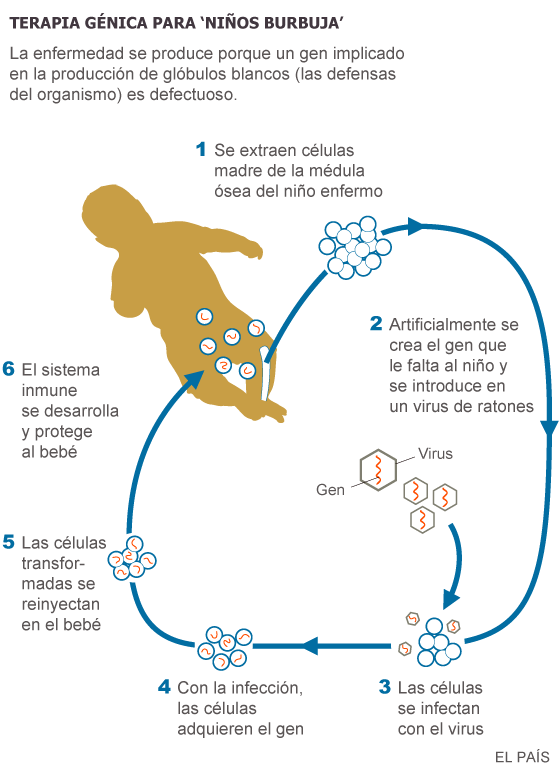
Kohn used a virus delivery system that he first developed in his lab in the 1990s to insert the corrected gene that produces the missing enzyme necessary for a healthy immune system into the blood forming stem cells in the bone marrow. The genetically corrected blood forming stem cells then produce T cells that will fight infection.


He and colleagues tested different viral vectors, modifying each and perfecting viral delivery as the best method to put the healthy ADA genes back into the bone marrow cells of the patients. With the newly-transplanted cells now able to produce the needed enzyme, they use the powerful self-renewal potential of stem cells to repopulate the blood stream and the child develops their own new, fully-functioning immune system.


"We were very happy that over the course of several clinical trials and after making refinements and improvements to the treatment protocol, we are now able to provide a cure for babies with this devastating disease using the child's own cells," said Kohn.


The next step is to seek FDA approval for the gene therapy in the hopes that all children with ADA-deficient SCID will be able to benefit from the treatment.


This cutting-edge research also lays the groundwork for the successful gene therapy to be clinically tested for treatment of sickle cell disease, with trials set to begin next year.


"We've been working for the last five years to take the success we've had with this stem cell gene therapy for SCID to sickle cell," said Kohn. "We now have the potential to take the gene that blocks sickling and get it into enough of a patient's stem cells to block the disease."


The Padilla-Vaccaro Family: One Child's Story


Only weeks after giving birth to fraternal twins in 2012, Alysia Padilla-Vaccaro quickly felt something was wrong with one of her daughters, Evangelina, now two years old.


"I was told that it was the stress, or the fear of being a new mom, but I just knew something wasn't right," said Padilla-Vaccaro. "Then I was informed that Evangelina had absolutely no immune system. That anything that could make her sick, would kill her. It was literally the worst time of my life."


Alysia and her husband Christian, of Corona, California, brought Evangelina to see Dr. Kohn at UCLA. Soon after undergoing Dr. Kohn's stem cell gene therapy treatment, Evangelina's new immune system developed without side effects. Her T cell count began to rise and her ability to fight off illness and infection grew stronger.


Then Dr. Kohn told Alysia and Christian the good news. For the first time, they could hug and kiss their daughter and take Evangelina outside to meet the world.


"To finally kiss your child on the lips, to hold her, it's impossible to describe what a gift that is," Padilla-Vaccaro said. "I gave birth to my daughter, but Dr. Kohn gave my baby life."


sábado, 18 de octubre de 2014

Terapia celular para tratar a los bebés burbuja

Fuente: http://elpais.com/elpais/2014/10/15/ciencia/1413372486_108083.html


El niño chileno Gabriel Solís no vio la sonrisa de sus padres hasta los nueve meses de vida, a bordo de un avión que hacía la ruta Santiago de Chile-Boston. Allí, a unos 10.000 metros de altura, observó aquellas sonrisas por primera vez. Hasta entonces, sus padres estaban obligados a ponerse una mascarilla para acercarse a él, porque permanecía aislado del mundo en una habitación de hospital convertida en un búnker contra virus, bacterias y hongos.


Gabriel es un niño burbuja, afectado por una enfermedad congénita que anula las defensas de su organismo, "como John Travolta en la película El chico de la burbuja de plástico", según explica su madre, la economista chilena Carolina Riquelme. El niño nació el 2 de julio de 2011 en La Serena, una población playera del norte de Chile conocida como La Ciudad de las Iglesias, por la omnipresencia de la religión cristiana. Al principio, Gabriel era un bebé normal, pero a los cuatro meses y medio empezó a desarrollar su enfermedad, la inmunodeficiencia combinada grave ligada al cromosoma X, que afecta a uno o dos de cada 100.000 bebés.


El niño había nacido con una mutación grave en tan solo uno de sus 25.000 genes, el IL2RG, esencial para el desarrollo de las defensas del organismo. Aquella tara en el mundo microscópico obligó a sus médicos a encerrarlo en una habitación para pacientes con cáncer de la Clínica Santa María, en Santiago de Chile. “Fue un shock ver a nuestro hijo enfermo, obligado a vivir en aislamiento. Teníamos que entrar con mascarilla, él siempre nos veía con mascarilla. Y todos sus juguetes tenían que ser de plástico y lavables. Nada de peluches, nada que tuviera polvo”, recuerda Riquelme, que dejó su trabajo y vivió aislada del mundo con el niño durante cinco meses.


Hoy, sin embargo, Gabriel lleva una vida normal y va a empezar la guardería, un cambio que su madre atribuye a “la presencia de Dios”, pero que quizá tenga una explicación bastante más terrenal y sofisticada. Aquel avión en el que el niño vio la sonrisa de sus padres por primera vez los acercaba al Centro de Oncología y Enfermedades de la Sangre Dana-Farber, en Boston. Allí les esperaba el pediatra David Williams, con un plan para Gabriel.


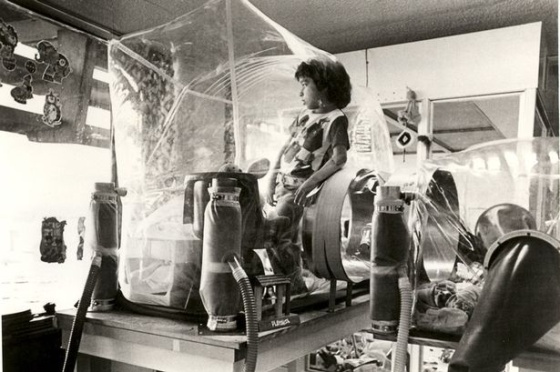
El niño David Vetter, en el que se basa la película 'El chico de la burbuja de plástico' (1976)


En las semanas siguientes, el equipo de Williams extrajo células inmaduras de la médula ósea del interior de los huesos del niño. Eran células madre productoras de sangre, capaces de generar glóbulos blancos, los soldados del organismo contra infecciones causadas por virus, bacterias y hongos. En un laboratorio especializado, aquellas células jóvenes fueron expuestas a un virus modificado con el gen que necesitaba Gabriel. El virus, originalmente de ratón y con una envoltura añadida de otro virus que afecta a los gibones, es capaz de insertar material genético en las células humanas e hizo su trabajo. Y los médicos devolvieron al niño sus células madre, ya con el nuevo gen insertado, inyectándoselas en vena, a razón de 7,8 millones de células por cada kilo de peso.


“Su pronóstico es muy bueno. Debería de ser capaz de llevar una vida casi normal a partir de ahora”, se felicita Williams, que acaba de publicar su investigación con Gabriel y otros ocho niños en la revista The New England Journal of Medicine. Uno de los chavales murió por una infección contraída antes de comenzar el estudio. Los demás siguen vivos al cabo de entre uno y tres años después de recibir el tratamiento. Para el pediatra, estos resultados hacen que esta nueva terapia génica sea prometedora para “muchas otras enfermedades, como la hemofilia, la talasemia, formas congénitas de ceguera y la anemia falciforme, por ejemplo”.


El farmacólogo Juan Bueren aplaude los resultados con Gabriel y recuerda el fracaso de las primeras terapias génicas, arrancadas en 2000. Entonces, un equipo del Hospital Necker de París empleó el mismo procedimiento con 11 niños, pero los ensayos tuvieron que detenerse después de que dos de ellos desarrollaran leucemia. “Utilizaron virus muy potentes, que llegaban a activar genes adyacentes al gen añadido, incluidos algunos relacionados con el cáncer", explica Bueren, experto en estas terapias innovadoras en el organismo público español CIEMAT.


Sin embargo, el investigador es cauto ante el nuevo tratamiento. “Hay que esperar, porque sólo han pasado tres años, pero es cierto que todavía no se están observando los fenómenos que se dieron en 2000”, opina. Los virus empleados en Gabriel tienen un efecto más débil que los utilizados hace 14 años, como recalca Williams: “El nuevo virus parece más seguro, porque activa mucho menos los genes”. El fantasma de la leucemia que congeló la investigación en terapias génicas en sus comienzos, de momento, parece lejano.


El éxito del equipo de Boston se une al de otros dos ensayos clínicos presentados el año pasado. Científicos italianos del Instituto San Raffaele Telethon, en Milán, anunciaron entonces que habían logrado detener otras dos enfermedades hereditarias en seis niños, afectados o bien por la leucodistrofia metacromática, en la que un gen defectuoso provoca movimientos musculares anormales y cambios de personalidad, o bien por el síndrome de Wiskott-Aldrich, que afecta a la sangre y desencadena una inmunodeficiencia. Los investigadores emplearon el virus del SIDA modificado para introducirles el gen que necesitaban y los chavales vivían casi sin síntomas dos años después del tratamiento.


En ninguno de los casos nadie canta victoria todavía. El propio Gabriel será sometido a seguimiento durante 15 años. Sin embargo, el mismo día en el que se publicaba el estudio científico, sus padres se fueron con el niño de vacaciones por primera vez, a visitar a sus familiares en Córdoba (Argentina). Y Gabriel iba contento, como celebra su madre: “Después de tanto plástico, ahora le encantan las cosas suavecitas. Su juguete favorito es un osito de peluche”. Gabriel no lo ha bautizado. Sólo dice: "Mi osito".

domingo, 12 de octubre de 2014

Gene therapy shows potential for 'bubble boy' disease

Fuente: http://consumer.healthday.com/cancer-information-5/leukemia-cancer-news-99/gene-therapy-shows-promise-for-bubble-boy-disease-692533.html


A new form of gene therapy may offer a safe and effective way to treat "bubble boy" disease -- a severe immune deficiency that is fatal unless treated in infancy.

Researchers have long known that gene therapy can cure the disease, known medically as severe combined immunodeficiency, or SCID. Over a decade ago, trials in Europe showed that gene therapy worked -- but five of the 20 children treated developed leukemia (a type of cancer) within two to five years, according to background information in the study.

In the new trial, reported in the New England Journal of Medicine, researchers refined the gene therapy approach to hopefully negate the leukemia risk.

Eight of nine children who received the therapy are still alive one to three years later, the investigators report. And so far, none has developed leukemia.

It's too early to say the therapy carries no leukemia risk, cautioned researcher Dr. David Williams, a pediatric hematologist/oncologist at Dana-Farber Cancer Institute and Boston Children's Hospital.

"We'll continue to follow these children for 15 years," Williams said.

But based on the early results, he noted, the tweaked gene therapy appears as effective at generating a functional immune system as the earlier form of treatment.

SCID refers to a group of rare genetic disorders that all but eliminate the immune system, according to the Immune Deficiency Foundation (IDF). That leaves children at high risk of severe infections.

In the United States, 40 to 100 babies are born with SCID each year, according to the National Institutes of Health. Early detection is becoming more common because a screening test recently became available. So far, 24 states and the District of Columbia have adopted the test, according to the IDF.

The term "bubble boy" became popular after a Texas boy with SCID lived in a plastic bubble to ward off infections. The boy, David Vetter, died in 1984 at the age of 12, after an unsuccessful bone marrow transplant -- an attempt to give him a functioning immune system.

Today, children with SCID have a high chance of survival if they receive a transplant of blood stem cells -- primitive cells that give rise to the immune system.

Ideally, those stem cells come from a sibling who is a perfect match for certain immune-system genes. If that's not possible, a parent or genetically matched donor may be able to donate.

"But there are kids for whom no donor is available. Or for other reasons a transplant isn't an option," Williams said.

And, a study just published in July found that the timing of the transplant is key. For the best chances of a cure, it should be done early -- ideally by the age of about 3.5 months -- and before a child has suffered any infections.

In the new trial, eight of the nine boys had serious infections at the time of their treatment with gene therapy, and all but one survived. All of the boys had what's known as X-linked SCID, a form of the disease that only causes disease symptoms in boys, according to IDF.

X-linked SCID is the most common form of SCID, according to the IDF. It's caused by mutations in a gene called IL2G, according to the study. Gene therapy corrects the flaw by inserting a normal copy of the gene into a child's own stem cells; those cells go on to produce normal immune-system cells. To get the gene into a child's cells, researchers use a modified virus whose own genes have been largely removed.

But the virus used in the original SCID trials had an unfortunate side effect in some children: It activated certain cancer-promoting genes, according to background information in the study.

The virus developed for the new trial is "self-inactivating," and designed to minimize the chances of activating cancer genes, according to the researchers.

Only time will tell if the therapy is free of leukemia risk.

"The early results are encouraging, but this needs more time to mature," said Dr. Richard O'Reilly, chief of pediatric bone marrow transplant at Memorial Sloan-Kettering Cancer Center in New York City.

"This study is impressive," said O'Reilly, who was not involved in the current research. "Many of the children had significant infections, and would be at high risk of [dying] with a stem cell transplant."

The fact that survival was so high in babies with infections is "quite striking," O'Reilly noted.

O'Reilly was one of the researchers on the recent stem cell transplant study. That study found that when babies were older than 3.5 months and had an active infection at the time of their transplant, half died, according to that study, which was published in the July 31 issue of the New England Journal of Medicine.

Gene therapy could offer an alternative to stem cell transplants for infants with infections, according to Williams. But whatever way the therapy ultimately fits in, it will not replace stem cell transplants, Williams added.


More information

The Immune Deficiency Foundation has more on transplants and gene therapy for SCID.

SOURCE: David Williams, M.D., chief, hematology/oncology, Dana-Farber/Boston Children's Cancer and Blood Disorders Center, Boston, Mass.; Richard O'Reilly, M.D., chief, pediatric bone marrow transplant service, Memorial Sloan-Kettering Cancer Center, New York City; Oct. 9, 2014, New England Journal of Medicine


domingo, 3 de agosto de 2014

El trasplante de células madre hematopoyéticas, resulta un método efectivo en niños con inmunodeficiencia combinada grave

Fuente: http://www.diariomedico.com/2014/07/31/area-cientifica/especialidades/inmunologia/trasplante-celulas-madre-hematopoyeticas-resulta-metodo-efectivo-ninos-inmunodeficiencia-combinada-grave


Los bebés que han nacido con una inmunodeficiencia combinada grave (SCID por sus siglas en inglés) pueden ser tratados con éxito mediante un trasplante de células madre hematopoyéticas, según un estudio realizado por investigadores del Memorial Sloan Kettering (MSK), en Estados Unidos.


Los autores de la investigación, publicada en New England Journal of Medicine, analizaron los casos de 240 pacientes y observaron que muchos trasplantes de las células madre hematopoyéticas habían tenido resultados altamente exitosos, especialmente en los realizados a una edad temprana. De los niños que recibieron un trasplante dentro de los tres meses y medio después del nacimiento, el 94 por ciento siguieron con vida cinco años después. Entre los pacientes que no tenían un hermano que fuera compatible, la tasa de supervivencia durante los cinco años siguientes fue significativamente alta, del 77 al 93 por ciento.

"Estos resultados confirman que los trasplantes para SCID tienen éxito en niños pequeños, pero también muestra que algunas niños con esta patología pueden ser tratados, con altas probabilidades de curarse, con un trasplante procedente de algún pariente o un donante no emparentado, y no solo con uno de su hermano o hermana", ha explicado Richard J. O'Reilly, principal autor del estudio y presidente del Departamento Pediátrico de MSK y director del Servicio Pediátrico de Trasplante de Médula Ósea.

Sin embargo, según indica O'Reilly, un factor crítico que hay que controlar es el de garantizar que el niño no tenga ninguna infección en el momento del trasplante. Por ello, advierte de que es importante realizar una exploración amplia y precisa en los casos de SCID para que los médicos puedan intervenir inmediatamente.

En 1981, MSK presentó la depleción de células T, un procedimiento innovador para mejorar el éxito de los trasplantes. La mayoría de los puntos de referencia importantes en el desarrollo del trasplante de células y terapias provienen de los estudios de tesis referentes a los casos de niños que padecen un trastorno del sistema inmunológico genético letal.