Mostrando entradas con la etiqueta radiación. Mostrar todas las entradas

domingo, 15 de febrero de 2015

Células madre reprogramadas reparan el daño cerebral causado por la radioterapia

Fuente: http://www.abc.es/salud/noticias/20150205/abci-cancer-celulas-madre-radioterapia-201502051727.html


Ser capaz de restaurar el daño de la radiación podría implicar dos cosas: la mejora de la calidad de vida de los supervivientes y la expansión de la ventana terapéutica de este tratamiento.
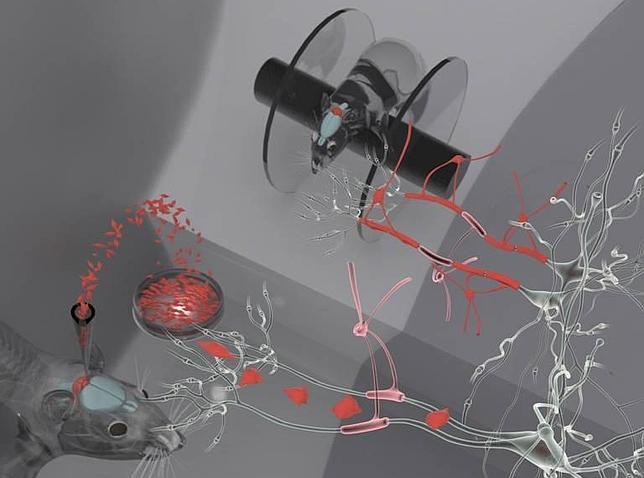


Para los pacientes con un tumor cerebral, la radiación es un tratamiento potente que puede salvar vidas, pero también causar un perjuicio considerable e incluso permanente al cerebro. Ahora, a través de experimentos preclínicos realizados en ratas, investigadores del Centro de Cáncer Memorial Sloan Kettering (EE.UU.) han desarrollado un método para convertir células madre humanas en células programadas para reparar los daños en el cerebro. Las ratas tratadas con las células humanas recuperaron las funciones cognitivas y motoras que habían perdido tras la radiación cerebral. Los hallazgos se publican en «Cell Stem Cell».


La radioterapia en el cáncer cerebral altera las células progenitoras y no hay tratamiento disponible para restaurarlas. Dichas células, llamadas oligodendrocitos mielinizantes, son fundamentales para el blindaje y la reparación de las neuronas del cerebro durante toda la vida.


El equipo dirigido por Viviane Tabar y Jinghua Piao se preguntó si las células madre podrían ser inducidas para reemplazar estas células progenitoras perdidas. Los investigadores vieron que se podía hacer mediante cultivo de células madre -embrionarias humanas o células madre pluripotentes inducidas derivadas de la piel- en presencia de ciertos factores de crecimiento y otras moléculas.


A continuación, los investigadores utilizaron las células progenitoras oligodendrocíticas cultivadas en el laboratorio para el tratamiento de ratas que habían sido expuestas a irradiación del cerebro. Así vieron que cuando las células fueron inyectadas en ciertas regiones del cerebro, se lograba una reparación cerebral y las ratas recuperaron las habilidades cognitivas y motoras que se habían perdido debido a la exposición a la radiación. El tratamiento también pareció ser seguro: ninguno de los animales desarrolló tumores o tipos de células inapropiadas en el cerebro.


«Ser capaz de reparar el daño por radiación podría implicar dos cosas importantes: la mejora de la calidad de vida de los supervivientes y, potencialmente, la expansión de la ventana terapéutica de la radioterapia», señala Tabar. Y aunque todavía debe ser probado, Tabar cree que si se puede reparar el cerebro de manera efectiva, «podríamos ser más audaces con las dosis de radiación, dentro de los límites, algo que podría ser especialmente importante en los niños, en los cuales se aplican dosis bajas de radiación».


sábado, 3 de enero de 2015

Reprogramming adult stem cells may prevent cancer after radiation

Fuente: http://www.sciencecodex.com/reprogramming_stem_cells_may_prevent_cancer_after_radiation-148121

The body has evolved ways to get rid of faulty stem cells and a new study shows that one of these ways is a "program" that makes stem cells damaged by radiation differentiate into other cells that can no longer survive forever. Radiation makes a stem cell lose its "stemness." That makes sense: you don't want damaged stem cells sticking around to crank out damaged cells.


The study also shows that this same safeguard of "programmed mediocrity" that weeds out stem cells damaged by radiation allows blood cancers to grow in cases when the full body is irradiated. And by reprogramming this safeguard, we may be able to prevent cancer in the aftermath of full body radiation.


"The body didn't evolve to deal with leaking nuclear reactors and CT scans. It evolved to deal with only a few cells at a time receiving dangerous doses of radiation or other insults to their DNA," says James DeGregori, PhD, investigator at the CU Cancer Center, professor of Biochemistry and Molecular Genetics at the CU School of Medicine, and the paper's senior author.


DeGregori, doctoral student Courtney Fleenor, and colleagues explored the effects of full body radiation on the blood stem cells of mice. In this case, radiation increased the probability that cells in the hematopoietic stem cell system would differentiate. Only, while most followed this instruction, a few did not. Stem cells with a very specific mutation were able to disobey the instruction to differentiate and retain their "stemness". Genetic inhibition of the gene C/EBPA allowed a few stem cells to keep the ability to act as stem cells. With competition from other, healthy stem cells removed, the stem cells with reduced C/EBPA were able to dominate the blood cell production system. In this way, the blood system transitioned from C/EBPA+ cells to primarily C/EBPA- cells.


Mutations and other genetic alterations resulting in inhibition of the C/EBPA gene are associated with acute myeloid leukemia in humans. Thus, it's not mutations caused by radiation but a blood system reengineered by faulty stem cells that creates cancer risk in people who have experienced radiation.


"It's about evolution driven by natural selection," DeGregori says. "In a healthy blood system, healthy stem cells out-compete stem cells that happen to have the C/EBPA mutation. But when radiation reduces the heath and robustness (what we call 'fitness') of the stem cell population, the mutated cells that have been there all along are suddenly given the opportunity to take over."


Think about it in terms of chipmunks and squirrels: reducing an ecosystem's population of chipmunks may allow squirrels to flourish - especially if the way in which chipmunks are reduced changes the ecosystem to favor squirrels, similar to how radiation changes the body in a way that favors C/EBPA-mutant stem cells).


These studies don't just tell us why radiation makes hematopoietic stem cells (HSCs) differentiate; they also show that by activating a stem cell maintenance pathway, we can keep it from happening. Even months after irradiation, artificially activating the NOTCH signaling pathway of irradiated HSCs lets them act "stemmy" again - restarting the blood cell assembly line in these HSCs that would have otherwise differentiated in response to radiation.


When DeGregori, Fleenor and colleagues activated NOTCH in previously irradiated HSCs, it kept the population of dangerous, C/EBPA cells at bay. Competition from non-C/EBPA-mutant stem cells, with their fitness restored by NOTCH activation, meant that there was no evolutionary space for C/EBPA-mutant stem cells.


"If I were working in a situation in which I was likely to experience full-body radiation, I would freeze a bunch of my HSCs," DeGregori says, explaining that an infusion of healthy HSCs after radiation exposure would likely allow the healthy blood system to out-compete the radiation-exposed HSC with their "programmed mediocrity" (increased differentiation) and even HSC with cancer-causing mutations. "But there's also hope that in the future, we could offer drugs that would restore the fitness of stem cells left over after radiation."


More information: Stem Cells doi:10.1002/stem.1936