Mostrando entradas con la etiqueta oligodendrocitos. Mostrar todas las entradas

domingo, 15 de febrero de 2015

Células madre reprogramadas reparan el daño cerebral causado por la radioterapia

Fuente: http://www.abc.es/salud/noticias/20150205/abci-cancer-celulas-madre-radioterapia-201502051727.html


Ser capaz de restaurar el daño de la radiación podría implicar dos cosas: la mejora de la calidad de vida de los supervivientes y la expansión de la ventana terapéutica de este tratamiento.
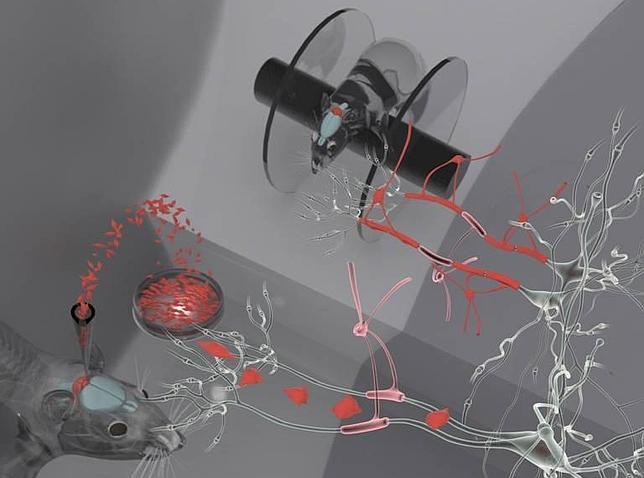


Para los pacientes con un tumor cerebral, la radiación es un tratamiento potente que puede salvar vidas, pero también causar un perjuicio considerable e incluso permanente al cerebro. Ahora, a través de experimentos preclínicos realizados en ratas, investigadores del Centro de Cáncer Memorial Sloan Kettering (EE.UU.) han desarrollado un método para convertir células madre humanas en células programadas para reparar los daños en el cerebro. Las ratas tratadas con las células humanas recuperaron las funciones cognitivas y motoras que habían perdido tras la radiación cerebral. Los hallazgos se publican en «Cell Stem Cell».


La radioterapia en el cáncer cerebral altera las células progenitoras y no hay tratamiento disponible para restaurarlas. Dichas células, llamadas oligodendrocitos mielinizantes, son fundamentales para el blindaje y la reparación de las neuronas del cerebro durante toda la vida.


El equipo dirigido por Viviane Tabar y Jinghua Piao se preguntó si las células madre podrían ser inducidas para reemplazar estas células progenitoras perdidas. Los investigadores vieron que se podía hacer mediante cultivo de células madre -embrionarias humanas o células madre pluripotentes inducidas derivadas de la piel- en presencia de ciertos factores de crecimiento y otras moléculas.


A continuación, los investigadores utilizaron las células progenitoras oligodendrocíticas cultivadas en el laboratorio para el tratamiento de ratas que habían sido expuestas a irradiación del cerebro. Así vieron que cuando las células fueron inyectadas en ciertas regiones del cerebro, se lograba una reparación cerebral y las ratas recuperaron las habilidades cognitivas y motoras que se habían perdido debido a la exposición a la radiación. El tratamiento también pareció ser seguro: ninguno de los animales desarrolló tumores o tipos de células inapropiadas en el cerebro.


«Ser capaz de reparar el daño por radiación podría implicar dos cosas importantes: la mejora de la calidad de vida de los supervivientes y, potencialmente, la expansión de la ventana terapéutica de la radioterapia», señala Tabar. Y aunque todavía debe ser probado, Tabar cree que si se puede reparar el cerebro de manera efectiva, «podríamos ser más audaces con las dosis de radiación, dentro de los límites, algo que podría ser especialmente importante en los niños, en los cuales se aplican dosis bajas de radiación».


lunes, 30 de junio de 2014

'Master switch' for myelination in human brain stem cells is identified

Fuente: http://www.sciencecodex.com/master_switch_for_myelination_in_human_brain_stem_cells_is_identified-136658


Scientists at the University at Buffalo have identified the single transcription factor or "master switch" that initiates the critical myelination process in the brain. The research will be published online in Proceedings of the National Academy of Sciences (PNAS).


The identification of this factor, SOX10, in human brain cells, brings researchers closer to the goal of treating multiple sclerosis (MS) by transplanting into patients the brain cells that make myelin.

"Now that we have identified SOX10 as an initiator of myelination, we can work on developing a viral or pharmaceutical approach to inducing it in MS patients," says Fraser Sim, PhD, senior author on the paper and assistant professor in the UB Department of Pharmacology and Toxicology in the School of Medicine and Biomedical Sciences.

"If we could create a small molecule drug that would switch on SOX10, that would be therapeutically important," he adds.

Stem cell therapy is seen as having dramatic potential for treating MS, but there are key obstacles, especially the length of time it takes for progenitor cells to turn into oligodendrocytes, the brain's myelin-making cells.

Using currently available methods, Sim explains, it can take as long as a year to generate a sufficient number of human oligodendrocyte cells to treat a single MS patient.

That's partly because there are so many steps: the skin or blood cell must be turned into induced pluripotent stem cells, which can differentiate into any other type of cell and from which neural progenitor cells can be produced. Those progenitor cells then must undergo differentiation to oligodendrocyte progenitors that are capable of ultimately producing the oligodendrocytes.

"Ideally, we'd like to get directly to oligodendrocyte progenitors," says Sim. "The new results are a stepping stone to the overall goal of being able to take a patient's skin cells or blood cells and create from them oligodendrocyte progenitors," he says.

Using fetal (not embryonic) brain stem cells, the UB researchers searched for transcription factors that are absent in neural progenitor cells and switched on in oligodendrocyte progenitor cells.


While neural progenitor cells are capable of producing myelin, they do so very poorly and can cause undesirable outcomes in patients, so the only candidate for transplantation is the oligodendrocyte progenitor.

"The ideal cell to transplant is the oligodendrocyte progenitor cell," Sim says. "The question was, could we use one of these transcription factors to turn the neural progenitor cell into an oligodendrocyte progenitor cell?"

To find out, they looked at different characteristics, such as mRNA expression, protein and whole gene expression and functional studies.

"We narrowed it down to a short list of 10 transcription factors that were made exclusively by oligodendrocyte progenitor cells," says Sim.

"Among all 10 factors that we studied, only SOX10 was able to make the switch from neural progenitor to oligodendrocyte progenitor cell," says Sim.

In addition, the UB researchers found that SOX10 could expedite the transformation from oligodendrocyte progenitor cell to differentiation as an oligodendrocyte, the myelin-producing cell and the ultimate treatment goal for MS.

"SOX10 facilitates both steps," says Sim.

That's tantalizing, he says, because one of the biggest problems with MS is that cells get stuck in the step between the oligodendrocyte progenitor cell and the oligodendrocyte.

"In MS, first the immune system attacks the brain, but the brain is unable to repair itself effectively," explains Sim. "If we could boost the regeneration step by facilitating formation of oligodendrocytes from progenitor cells, then we might be able to keep patients in the relapsing remitting stage of MS, a far less burdensome stage of disease than the later, progressive stage."

Sim is also an investigator with other scientists at UB and the University of Rochester on the $12.1 million New York State Stem Cell Science award led by SUNY Upstate Medical Center. The research will test the safety and effectiveness of implanting stem cells that can reproduce myelin into the central nervous system of MS patients.