Mostrando entradas con la etiqueta neoplasias mieloproliferativas. Mostrar todas las entradas

domingo, 7 de diciembre de 2014

Las hormonas sexuales femeninas podrían proteger frente a algunas leucemias

Fuente: http://noticiasdelaciencia.com/not/12136/las-hormonas-sexuales-femeninas-protegen-frente-a-algunas-leucemias/es/


El hecho de que los hombres tengan más riesgo de desarrollar leucemia que las mujeres hizo que científicos del Centro Nacional de Investigaciones Cardiovasculares (CNIC) en España comenzaran a investigar la relación entre células madre sanguíneas y hormonas sexuales femeninas.


Los resultados de su trabajo sostienen que dichas hormonas, los estrógenos, son capaces de regular la actividad de las células madre sanguíneas de la médula ósea e influir así en el desarrollo de algunos tipos de leucemia y otros trastornos de la sangre.


Este hallazgo, publicado en la última edición de la revista Cell Stem Cell, puede explotarse en el tratamiento de ciertas leucemias para las que hoy no existen terapias curativas definitivas, las pertenecientes al grupo de las llamadas neoplasias mieloproliferativas.


Los autores, dirigidos por Simón Méndez-Ferrer, del CNIC –en colaboración con los equipos de Jürg Schwaller y Radek Skoda, del Hospital Universitario de Basilea (Suiza)–, han demostrado en ratones que un tratamiento ya aprobado y ampliamente utilizado para el cáncer de mama, el tamoxifeno, bloquea los síntomas y la progresión de dichas neoplasias mieloproliferativas.


Como explica Méndez-Ferrer, “se desconocen las causas de la diferente incidencia de leucemias entre hombres y mujeres, pero las hormonas sexuales, como los estrógenos, podrían explicar al menos parcialmente estas diferencias”.


El investigador aclara que, aunque se sabía que algunos tipos de células sanguíneas estaban regulados por estrógenos, hasta ahora se desconocía su influencia en las células madre sanguíneas, incluyendo aquellas causantes de las neoplasias mieloproliferativas.


A partir de este hallazgo, los científicos descubrieron una importante implicación práctica. “En este trabajo se ha demostrado que el tamoxifeno tiene efectos específicos sobre determinadas células de la médula ósea, en concreto sobre las células madre sanguíneas y su descendencia más inmediata, los llamados progenitores multipotentes”, señala Abel Sánchez-Aguilera, otro de los autores.


En la imagen puede verse al grupo de investigación liderado por Simón Méndez-Ferrer.


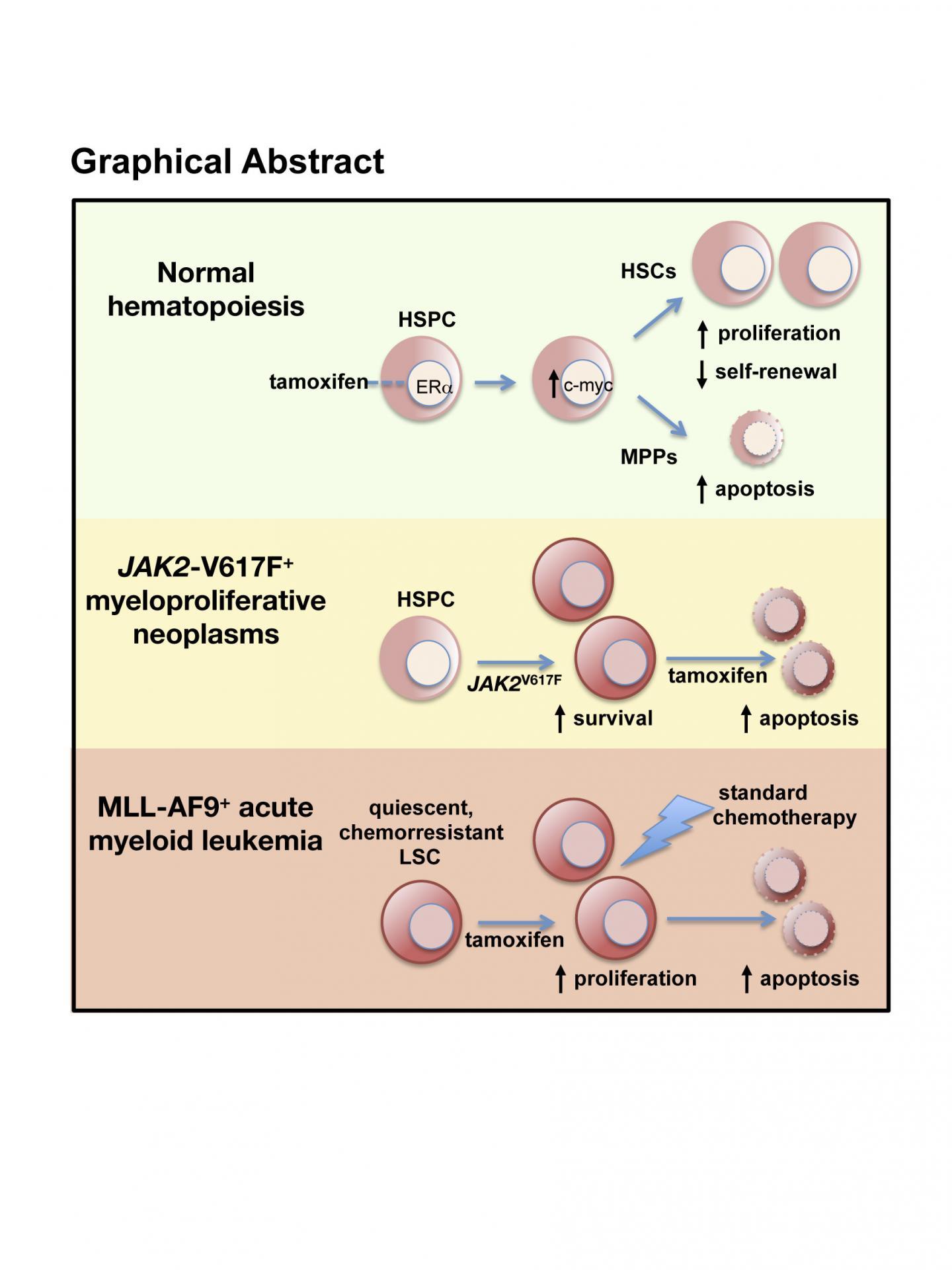
La investigación demostró que el tamoxifeno tenía un efecto muy distinto en ratones sanos y enfermos. Así, cuando se administra a ratones normales produce la muerte celular de los progenitores multipotentes, mientras que las células madre aceleran su división y pierden parcialmente su funcionalidad.


En cambio, cuando se administra a animales enfermos, se observa un bloqueo de los síntomas y la progresión de la enfermedad. En definitiva, un efecto terapéutico. A esto se le añade otra ventaja. Sorprendentemente, estos efectos no causan apenas ninguna alteración en el resto de las células sanguíneas, que se mantienen en niveles normales incluso después de tratamientos muy prolongados con el fármaco, no apreciándose ninguna toxicidad.


“El tamoxifeno restaura la muerte celular normal en la célula cancerígena y de esa manera impide que esa célula se acumule y frena específicamente la expansión de las células alteradas. Como lo hace en las células mutantes el efecto neto es una reducción en el número de células leucémicas. Esto no se ha conseguido de manera clara con otros tratamientos en la clínica”, señala Méndez-Ferrer.


Es más, se observó que, a diferencia de lo que ocurre en el cáncer de mama –donde el tamoxifeno bloquea la acción de los estrógenos– en las células sanguíneas el fármaco actúa imitando la función de la hormona.


“Aunque no se conoce exactamente la causa, el tamoxifeno parece tener un efecto más potente sobre las células leucémicas que sobre las sanas, lo que permite bloquear la enfermedad sin causar efectos secundarios importantes sobre las células normales de la sangre”, apunta Méndez-Ferrer.


Uno de los datos más destacados de esta investigación es su potencial traslado a la práctica clínica en un tiempo relativamente corto. “El hecho de que sea un fármaco ya aprobado para uso clínico, y suficientemente seguro, facilita enormemente la posible aplicación de estos resultados para el tratamiento de pacientes con neoplasias mieloproliferativas”, añade.


El científico puntualiza que todavía no se conocen los tiempos para que llegue a la clínica. “El tamoxifeno es un producto genérico en la actualidad y eso dificulta encontrar financiación de farmacéuticas para hacer el ensayo, aunque tenemos contactos con una empresa que estaría potencialmente interesada”, concluye. “Creemos que sería factible diseñar un ensayo clínico pronto”.


Las neoplasias mieloproliferativas, como la policitemia vera –un trastorno de la médula ósea que ocasiona principalmente demasiada producción de glóbulos rojos–, son tumores frecuentemente causados por una mutación en el gen que produce la proteína JAK2 en las células madre sanguíneas, y actualmente no existe para ellas ningún tratamiento curativo, con la excepción del trasplante de médula ósea, solo recomendado en una minoría de pacientes.


La enfermedad provoca la acumulación de células sanguíneas anormales y la degeneración de la médula ósea, procesos que en los animales enfermos son bloqueados por el tamoxifeno. El tratamiento es capaz de eliminar las células madre anormales, responsables últimas de la enfermedad (algo que las terapias actuales, incluyendo los inhibidores de JAK2, no consiguen hacer). 

sábado, 6 de diciembre de 2014

Female sex hormones can protect against the development of some blood disorders

Fuente: http://www.sciencecodex.com/female_sex_hormones_can_protect_against_the_development_of_some_blood_disorders-146831


This discovery has a potential application in the treatment of certain blood disorders for which there is currently no cure. The study was led by Dr. Simón Méndez-Ferrer of the CNIC, working in partnership with the laboratories of Doctors Jürg Schwaller and Radek Skoda of the University Hospital in Basel (Switzerland). The study's authors have demonstrated in mice that tamoxifen, a drug already approved and widely used for the treatment of breast cancer, blocks the symptoms and the progression of a specific group of blood disorders known as myeloproliferative neoplasms.


Dr. Méndez-Ferrer explains that scientists have known for some time that men have a higher risk than women of developing leukemia: "We didn't know the causes off this different incidence of leukemia between men and women, but sex hormones like estrogen could at least partly explain these differences." Although estrogens were known to regulate some types of blood cells, very little was known about their influence on blood stem cells, including those that cause myeloproliferative neoplasms.


From this starting point, the researchers discovered an important practical application. "In this study we demonstrate that tamoxifen has specific effects on certain cells in the bone marrow, the hematopoietic stem cells and their immediate descendants, known as multipotent progenitors," explains study author Abel Sánchez-Aguilera.
This is a graphic of the study. This discovery has a potential application in the treatment of certain blood disorders for which there is currently no cure.


The researchers found that tamoxifen had very distinct effects depending on whether the mice were healthy or sick. When administered to healthy animals, tamoxifen induced cell death of the multipotent progenitors, whereas the stem cells accelerated their division and partially lost their functionality. But when tamoxifen was administered to sick animals, symptoms disappeared and disease progression was blocked. In short, an effective therapy.


And there's another advantage. Surprisingly, these effects cause hardly any discernable alteration in the rest of the blood cells, which are maintained at normal levels even after prolonged treatment with the drug, showing no appreciable toxicity. Unlike the situation in breast cancer, where tamoxifen blocks the action of estrogens, in blood cells the team found that the drug acts by imitating the function of the hormone.


Myeloproliferative neoplasms, like polycythemia vera, are frequent tumors caused by a mutation in the gene that produces the protein JAK2 in hematopoietic stem cells. These diseases currently have no effective cure apart from bone marrow transplant, which is only possible for a small fraction of patients. The disease causes an accumulation of abnormal blood cells and the degeneration of the bone marrow, and in mice both these processes are blocked by treatment with tamoxifen. The treatment is able to eliminate the abnormal stem cells, the root cause of the disease, something that current therapies, including JAK2 inhibitors, don't manage.


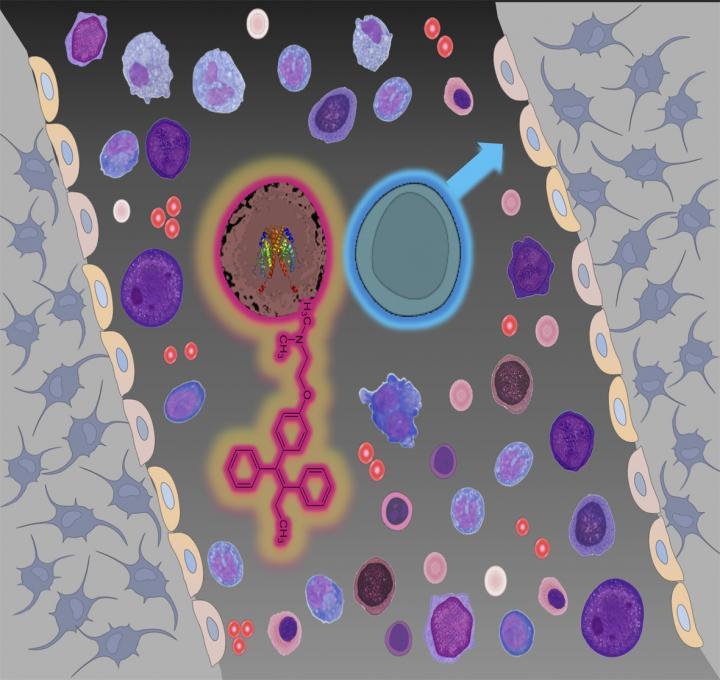
This study suggests that the blood stem cells (pink for female, blue for male) that, when altered, produce excessive blood cells (diseases called neoplasms) can be killed by female sex hormones. This finding potentially explains why these diseases and related cancers are more common in men than in women. The approved drug tamoxifen, whose chemical structure resembles female sex hormones and has been used in the picture to depict the feminine symbol (pink), can be used to block the development of blood neoplasms in male and female mice.


Dr. Simón Méndez-Ferrer points out that "although we don't know yet exactly why, tamoxifen appears to have a stronger effect on leukemic cells than on the healthy ones, which allows the disease to be blocked without producing major secondary effects on normal blood cells."


One of the most remarkable features of this study is its potential for translation to clinical practice in a relatively short time. The study's lead author concludes, "The fact that tamoxifen is already approved for clinical use and has an appropriate safety profile enormously increases the chances of these results leading to a clinical trial to test this potential therapy in patients with myeloproliferative neoplasms."


This image shows Simon Mendez - Ferrer's team.


Approved breast cancer drug offers hope for the treatment of blood disorders

Fuente: http://medicalxpress.com/news/2014-12-female-sex-hormones-blood-disorders.html

The discovery has a potential application in the treatment of certain blood disorders for which there is currently no cure. 


Blood cancers are more common in men than in women, but it has not been clear why this is the case. A study published by Cell Press in Cell Stem Cell provides an explanation, revealing that female sex hormones called estrogens regulate the survival, proliferation, and self-renewal of stem cells that give rise to blood cancers. Moreover, findings in mice with blood neoplasms—the excessive production of certain blood cells—suggest that a drug called tamoxifen, which targets estrogen receptors and is approved for the treatment of breast cancer, may also be a valuable strategy for blocking the development of blood neoplasms in humans.


"Our study demonstrates that targeting estrogen signaling with a clinically approved drug, at doses with an acceptable toxicity profile in humans, provides a novel potential therapeutic strategy for a set of neoplasms currently without a definitive cure," said senior study author Simón Méndez-Ferrer of the National Center for Cardiovascular Research (CNIC) in Madrid, Spain.


Myeloproliferative neoplasms cause large numbers of abnormal white blood cells to be produced and enter the bloodstream, potentially causing life-threatening symptoms. These diseases can lead to cancer and arise from blood cells called hematopoietic stem/progenitor cells (HSPCs), which give rise to all of the other blood cells. Leukemia and other blood cancers are more common in men than in women, strongly suggesting that sex hormones such as estrogens contribute to the development of these malignancies. But until now, it has not been clear whether estrogen signaling could directly control normal and cancerous HSPCs.


In the new study, Méndez-Ferrer and Abel Sánchez-Aguilera of CNIC found that HSPCs express estrogen receptors, and activation of these receptors with tamoxifen affected the survival, proliferation, and self-renewal of these cells. In mice with a genetic mutation associated with blood neoplasms, tamoxifen treatment blocked the excessive production of blood cells by restoring normal levels of programmed cell death in mutant cells. Moreover, tamoxifen enhanced the effects of conventional chemotherapy on cancerous cells in a mouse model of leukemia.


The study suggests that the blood stem cells (pink for female, blue for male) that, when altered, produce excessive blood cells (diseases called neoplasms) can be killed by female sex hormones. This finding potentially explains why these diseases and related cancers are more common in men than in women. The approved drug tamoxifen, whose chemical structure resembles female sex hormones and has been used in the picture to depict the feminine symbol (pink), can be used to block the development of blood neoplasms in male and female mice. 


"Our results suggest that tamoxifen, at a similar dose used for the treatment of other diseases, might be useful to treat myeloproliferative neoplasms at various stages, without being toxic to normal blood cells," Méndez-Ferrer says. "The fact that this drug is FDA-approved, readily available and sufficiently safe facilitates the potential translation of our results from the bench to the bedside."


More information: Cell Stem Cell, Sanchez-Aguilera et al.: "Estrogen signaling selectively induces apoptosis of hematopoietic progenitors and myeloid neoplasms without harming steady-state hematopoiesis" www.cell.com/cell-stem-cell/ab… 1934-5909(14)00514-1


domingo, 22 de junio de 2014

Microenvironment of hematopoietic stem cells can be a target for myeloproliferative disorders

Fuente: http://medicalxpress.com/news/2014-06-microenvironment-hematopoietic-stem-cells-myeloproliferative.html


This image depicts the authors of the study, including Dr. Mendez and others. Credit: CNIC


The protective microenvironment of the hematopoietic stem cell niche, which produces cells of the blood and the immune system, also protects against myeloproliferative neoplasia.


The discovery of a new therapeutic target for certain kinds of myeloproliferative disease is, without doubt, good news. This is precisely the discovery made by the Stem Cell Physiopathology group at the CNIC (the Spanish National Cardiovascular Research Center), led by Dr. Simón Méndez–Ferrer. The team has shown that the microenvironment that controls hematopoietic stem cells can be targeted for the treatment of a set of disorders called myeloproliferative neoplasias, the most prominent of which are chronic myelomonocytic leukemia (CMML), juvenile myelomonocytic leukemia (JMML), and atypical chronic myelogenous leukemia (CML).

The findings, published in Nature, demonstrate that these myeloproliferative neoplasias only appear after damage to the microenvironment that sustains and controls the hematopoietic stem cells—the cells that produce the cells of the blood and the immune system. Protecting this microenvironment, or niche, has thus emerged as a new route for the treatment of these diseases, for which there is currently no fully effective treatment.

"In normal conditions, the microenvironment is able to control the proliferation, differentiation and migration of the hematopoietic stem cell. A specific genetic mutation in these cells results in inflammatory injury to the microenvironment and this control breaks down. What our work shows is that this damage can be prevented or reversed by treatments that target the niche," explained Dr. Méndez-Ferrer.

Indeed, the same team of researchers has demonstrated the efficacy of a possible new treatment, which has been patented through the CNIC. The treatment involves an innovative use of clinically approved treatments for other diseases, so that, according to the authors, "it shouldn't be associated with adverse side effects". The new treatment route has been tested in animals and has received financial backing for a multicenter phase II clinical trial. "This study has a very strong translational and clinical potential", emphasized study first author Dr. Lorena Arranz, who added that "current treatment for myeloproliferative neoplasias is largely symptomatic and directed at preventing thrombosis and fatal cardiovascular events".

The only real cure available today is a bone marrow transplant, which is not advisable in patients over 50 years old. "This makes it important to identify new therapeutic targets for the development of effective treatments," the investigators conclude.


More information: Neuropathy of haematopoietic stem cell niche is essential for myeloproliferative neoplasms, DOI: 10.1038/nature13383


Journal reference: Nature